Cours de chant arabe / oriental et chants du monde pour débutant كورس غناء عربى فى باريس
Apprendre le chant arabe – oriental avec la chanteuse Selima Al Khalaf , d’origine irakienne ! Savoir découvrir et placer sa voix et sa respiration pour pouvoir chanter les chansons de Fairuz, Om Khatoum,Abdel Halim Hafiz, Assala….et la technique des chants du monde á Paris.
Cours de chant arabe / oriental pour débutants !

مدرسة الغناء في باريس مع المطربة
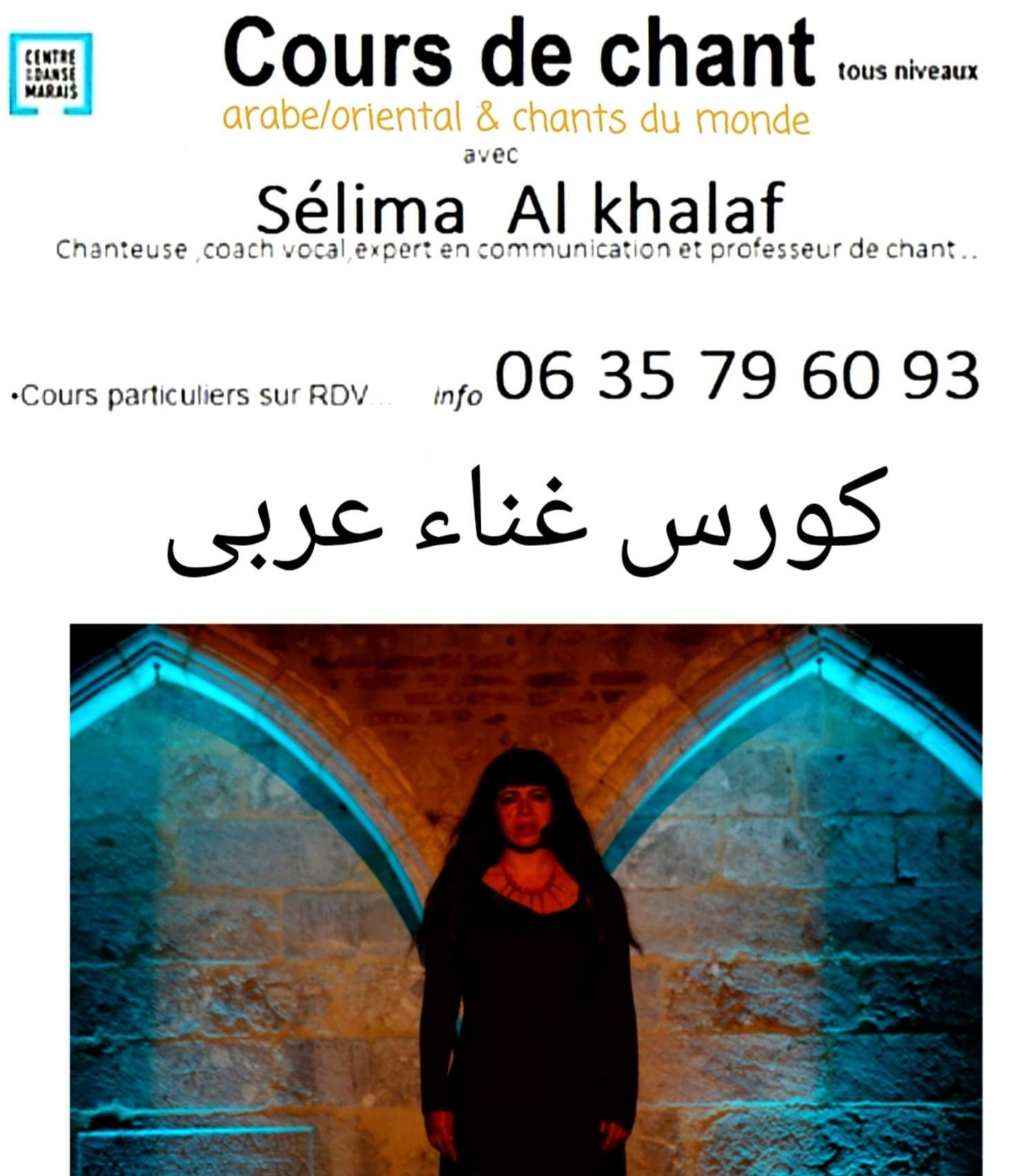
كورس غناء عربى فى باري

Cours de chant arabe et oriental à Paris
Développez votre voix, explorez les maqâms et exprimez toute l’émotion du chant oriental.
À propos
Le chant arabe et oriental est un art vocal ancestral, profondément lié à la poésie, à l’émotion et à l’improvisation. Ces cours s’adressent aux débutants comme aux chanteurs confirmés, dans un cadre bienveillant et personnalisé.
L’objectif est de libérer la voix, affiner l’écoute musicale et développer une interprétation authentique et expressive.
Cours individuels et collectifs
Apprendre le chant oriental pour :
- Une voix libre et souple!
- Une respiration maîtrisée!
- Une grande précision mélodique!
- Une expression plus intense
- et une meilleure écoute musicale

Learn to sing your favorit song with Selima Al khalaf in Paris Singing lessons in Paris at Centre du Marais!
Do you like to learn how to sing your favorit arabic song of Fairuz, Om Khatoum,Abdel Halim Hafiz, Assala….and also learn world music singing technic with songs from Turky,Armenia,Africa,Russia,Bulgaria…🌍🌍🌍
Traditional Arabic music was fixed at Damascus in the 8th century, and reached its heyday in Baghdad in the 9th century. Then it was exported to Andalusia by the famous artist Ziryab. It is particularly recognizable by the use of quarter tones and half tones. Four tones frame three intervals to form a mode (maqâm).
For any Information / reservation:
☎️ 0033/635 79 60 93
If the music of the Middle East likes to mix modes, that of the Maghreb prefers to keep the unity of the maqâm. There is no polyphony in Arabic music.
There are many musical instruments used according to the rhythm and the genre practiced: the ‘oud (lute) with four or six strings, the qanoun (zither), the lyre, the nay (reed flute), the darbouka (drum in skin ) and the douf (frame drum).
Classical Arab chamber music has taken off again thanks, among others, to the Iraqi artist Mounir Bachir.
Arabic song is booming nowadays. The first generation of singers updated the melodic heritage through the introduction of new instruments such as the violin and through the creation of modern texts.
Among the greatest Arab singers, we can mention the famous « Oum Kalthoum » specializing in Tarab (poetic ecstasy) and capable of keeping a large audience in suspense for hours, or the great Fayrouz.
The most common theme for lyrics is love. Thanks to the establishment of the orchestration, fitting in with the use of recent instruments like the electric guitar, and the exploration of new themes, the landscape of Arabic songs has been completely turned upside down. Thus, with Cheb Khaled, the rai accelerated this revolution. Likewise, thanks to artists like the Lebanese Marcel Khalifé who was inspired by the poetry of Mahmoud Darwich, oriental song has found a new direction, both poetic and patriotic.


